Sunday, July 27, 2008

Cleopatra and the Society of Architects

I imagine that most board gamers are like me and played with a lot of toys when they were kids. At some point, most of us give up playing with bits of plastic and move on to more intelligent pursuits. Some of us, still hold on to toys and while we don't play with them anymore we keep them around. They have their place on our desks and mantles, and we imagine their exploits and battles in our heads. This is why games like Warhammer, Twilight Imperium, and Battletech are so cool. They fire up our imaginations as we play out the battles in our minds, with minatures and terrain helping us play.

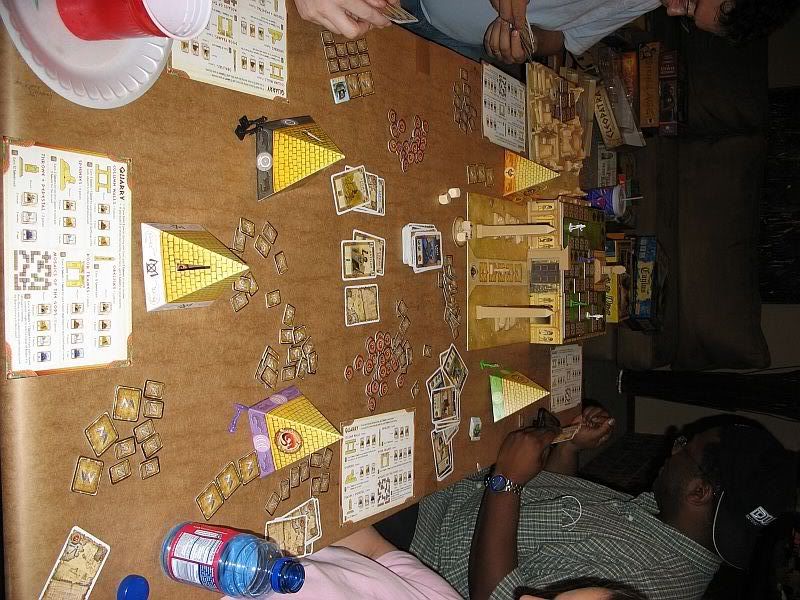
Cleopatra and the Society of Architects offers a similar kind of stimulation. The game has a lot of essential plastic bits and even the game's box is a part of the set up. In the game, the players take on the role of architects building a palace for the eponymous Egyptian queen. In order to complete the various parts of the building, such as the garden mosaics, throne, honorary obilisks, and sphinxes. As more elements of the palace are completed, Cleopatra approaches the front doors. Once she reaches the doors, the game ends and a winner is determined by the number of point accumulated by complete parts of the palace.

There's a catch though, and this part truly makes the game stand out. Since all the players are competing for the attention of the great Cleopatra, there are shortcuts the players can take to complete their projects before their rivals. Shady workers and specialists and ill-gotten goods speed up the completion of the palace, but at the cost of corruption at the hands of the crocodile-god Sobek. At the end of the game, the player with the most corruption loses. No reprieves, no appeals. The player with the most corruption comes in last place. Everyone else is judged on the points they've recieved over the course of the game.

Cleopatra is mechanically similar to other building games like Ticket to Ride in that every turn you must choose whether to gather resources or build. The key differnce here are the pieces, which are awesome. Some players have even taken to adding custom paintjobs to their bits. For this, the 1 hour or so play time, and the rather nasty-but-fun corruption mechanic, Cleopatra and the Society of Architects get a 7/10 VP. I'd say the only bad thing about game is putting it away, which can be somewhat of a hassle, BECAUSE OF ALL THE AWESOME PIECES. :D

Saturday, July 12, 2008

Railroad Tycoon

Computer games made into board games may seem like an unnecessary step backwards in the evolution of gaming. Computers, and by extention robots, are capable of keeping track of the minutae of a game such as dice rolls, modifiers, range and so forth, leaving the player with the burden of directing his overall strategy and having more fun. Did I mention how awesome robots are? It saddens me that I can't have an army of robots vacuuming my carpet, mowing my lawn and doing the busy work around the kitchen. Robots, and by extention computers, have no feelings and are generally unsociable folk. This is where board gaming wins, with the joy of human contact and the imperfection of not remembering that you did get a +2 from flanking and actually did drop that goblin.


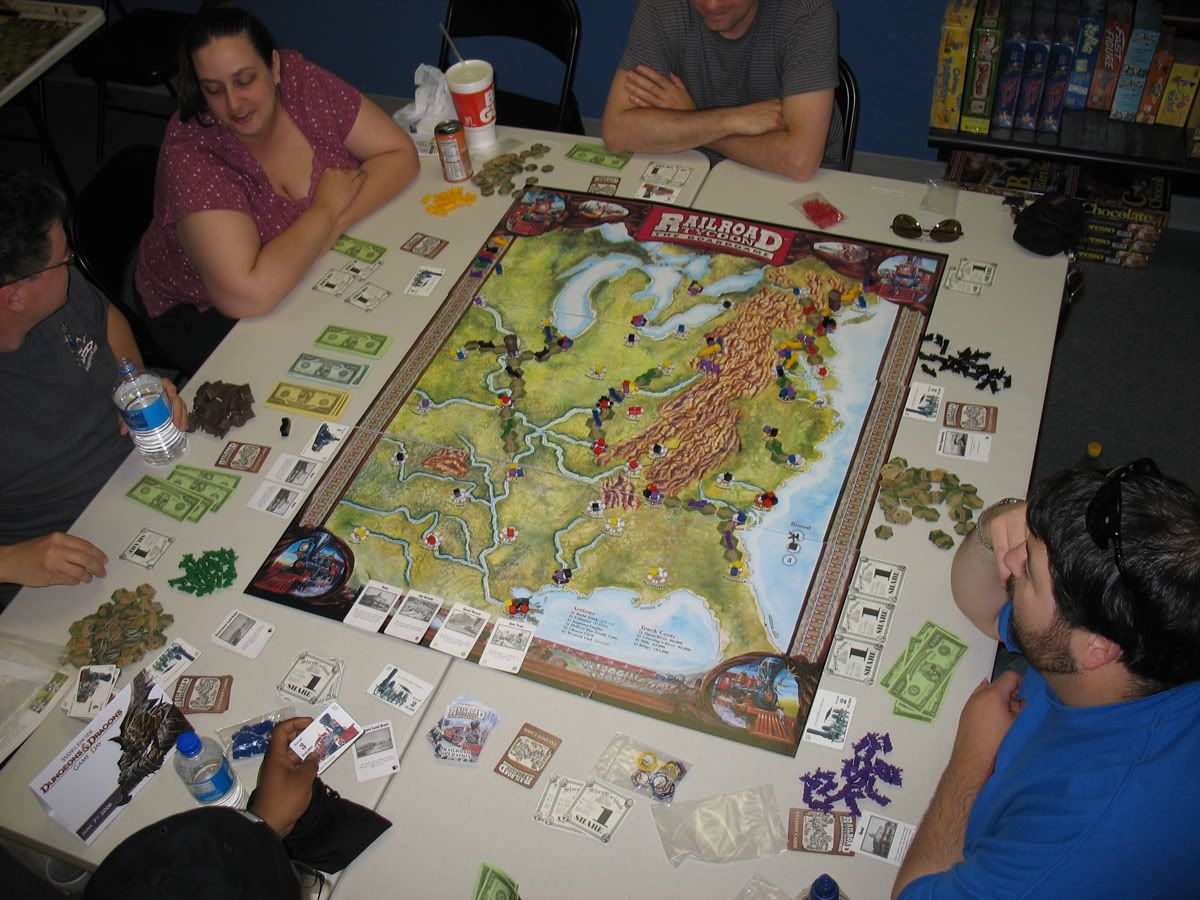
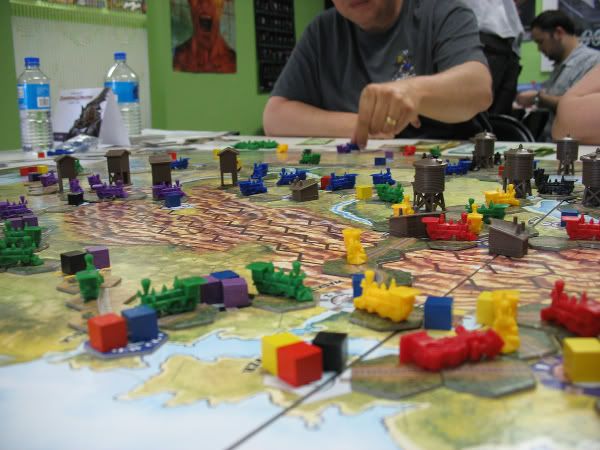
So how does one take an established and excellent computer game and make it into a board game that fun to play yet deep enough to excerise your brain? Well in the case of Railroad Tycoon, you take an established and excellent board game (Age of Steam), tart it up with new plastic bits and pieces, put in all on a HUGE board with a load of new art, and viola you've got Railroad Tycoon: The Board Game. Perhaps I'm not being entirely fair. Yes, Age of Steam is a great game but it's also pretty minimal in terms of art and bits. RT:tBG addresses that in spades, and did I mention the FUCKING HUGE board? Seriously, it's like it's own acrage. Twilight Imperium doesn't take up that much space. Huge.


The gameplay is just like Age of Steam. Players are the eponymous tycoons of the railroad, building connections between cities while delivering goods to gain income to make more connections that build into the end game. Victory is determined by the income you're bringing in, not necessarily cash in hand. You periodically have to put yourself in debt by issuing shares to gain capital to build your railroad.


So we've essentially got Age of Steam with better art, on a big ol' board. It's not really fair to say that RT:tBG is any better than AoS as far as game play, because it's pretty much the same except on a bigger field. Simply put if you like AoS, than you'll like Railroad Tycoon as long as you have the room for it. Both games rate a 8/10, as the bigger better art of Railroad Tycoon is cancelled out by the near logistical nightmare that entails getting this game on the table. The FUCKING HUGE table.

Monday, July 7, 2008

Dungeons & Dragons 4th Edition: Part 1

Player-killing. Wanna a song about it? Like to hear it? Here it goes...

Over the weekend, our gaming group got together to try out the Keep on the Shadowfell adventure. I'll just say that so far this module is quite brutal. I'm not sure that I've got anything good to compare it to, as I'm not personally familiar with anal penatration but it's pretty harsh. An ill-timed fight with one of the adventures mini-bosses ended with a total party kill, forcing us to make a whole new set of characters. This was after our original 1st level party of a human wizard, dragonborn paladin, dwarf cleric, and halfling rogue lost it's before-mentioned paladin (he was replaced by a human fighter). Even though we probably could have won the battle with the goblin brute mini-boss if we'd rested and recovered our daily powers, it would've still been an uphill battle. Our next iteration of the party was comprised of a tiefling warlord, eladrin wizard, half-elf warlock, elf ranger, and half-elf paladin. This very pointy party made easier work of the brute and his remaining lackies, despite his nasty damage output and 106 (!) HP. We've now learned that these fiends are in league with a cult that wishes to reopen a rift that could flood the world with Orcus' undead hordes. At this point we called it a session and we'll be finishing up the module over the next couple of weeks.

Overall, I'm enjoying the module and the new rule revision so far. The bloodbath of PCs has actually been pretty educational, as we've now seen all of the PC races and classes in action. So far, my impressions are:
  • 1st level guys are a lot more interesting, especially the wizard and cleric. In 3rd Edition, a 1st level wizard with an 18 INT had 3 1st level spells per day, or 4 if they were a specialist. A 1st level cleric with an 18 WIS had 4 1st levels spells as well. Both classes also had 3 0-level spells that were mostly useless. In 4th Edition, a cleric or wizard has at least 2 powers that he can use as often as he wants that are just as good as most 1st levels spells with the exception of magic missle, grease (which is sadly absent) and possibly Summon Monster 1. Both classes, as well as all other PC classes, also have a power that renews with each encounter and a power that renews every day. This gives every single class a depth at first level that's a lot of fun and very interesting. This isn't new information, as the preview material listed the power advancement for the classes. Playing is believing, and I'm now a fan of this whole new power scheme. Mostly.
  • While the lower levels are interesting, I can't help but think that at higher levels there won't be the same kind of variety. This is especially true of the classic spellcasting classes of cleric and wizard. Even martial adepts from The Book of Nine Swords have more maneuvers than any of the 4th Edition PC classes, and those maneuvers are more easily recovered and reused, even for swordsages.
  • I'm still not entirely convinced that a party can go without a cleric. We'll soon see as my Warlord tries to fill the leader role in the new party. Even so, it looks like while it's not essential to have a leader providing additional healing in a fights, it's still pretty fucking important. Second winds and healing surges are nice, but it's still something that most characters can only do once in a fight. A paladin seems to help in a pinch, but that's still a more limited resource than a 3rd edition cleric that can turn nearly all of his spells into a cure spell of some sort. The jury's still out on this.
  • More to the point of healing and hit points, everyone has more of them. I mean they really have a lot MOAR of them. As I mentioned before, the goblin brute mini-boss had over 100, while my first level wizard had 29 HP. The only "people" that seemed to have gotten the short end of the HP stick are the minion-typed monsters, who each have a single hit point while retaining OK defenses and damage output. While this makes wading through mooks more succinct and easier for the DM to track, it's made up for by all the other monsters types having just as many or more hit points than the PCs which can make for some very grindy fights. The damage output of the PCs is somewhat higher than before to make up for this, especially from rogues and rangers. Still, it can make for a somewhat prolonged fight when it gets down to the last few guys in an encounter.
  • All of the skill mechanics are simplier and more streamlined, even relating to social encounters. This seems to give the DM a lot more latitude in using these skills as he sees fit. Gone are the days when you can just waste skill points on that Profession: Sous Chef or Perform: Bass Accordian. Now the skill catagories are more broad and seemingly more useful to both the DM and the PCs.
Well, that's it for now. More later, and a final review of the module when we finish it.

Saturday, July 5, 2008

Battle Line

Two player games don't get a lot of notice from me. It's probably because I love the dynamics that come with having a group of people play a game. It started with Magic: The Gathering where I hated dualing, but loved building and using decks designed for multiplayer as it was much more interesting for me. These days the only two-player games that I partake of are the occasional games of Mastermind or the bedtime-frolicking with the girl, which has all of the negotiations, pain, thrill, heart-break, area-denial, and victory conditions of the best board games around. Yes, I just compared my married love life to a fucking board game. Blow me. :D

Then comes along Battle Line, a card game for two players that has a theme rooted in ancient warfare. The game has a Troop deck with cards numbered 1 to 10 in 6 colors or suites. Additionally there's also a rule-breaking Tactics deck that sees limited but powerful use. There are nine flags that represent the eponymous battle line. Players in turn play up to three cards in those areas in order to try and get essentially a better 3-card poker hand than their opponent. If a player can prove that their hand cannot be beaten, excepting the intervention of Tactics cards, that player claims the flag. The game is over when a player takes any five of the nine flags or when a player takes three adjacent flags, which represents an overrun in that section of the line.


The games theme, the types of soliders printed on the cards from lowly pikemen to mighty war elephants, is awesome. The game actually plays pretty fast (depending on the players of course) and the endgame is wrought with game-breaking decision. Frankly the games only problem is that it's almost too short. This is easily remedied by playing a best of 3, 5, 7, etc game series. At $20, it's well worth it for any size gaming group.


Battle line gets a 10 of 10 VP from me. The game is just about perfect and deserves a spot in everybody's gaming library.

Tuesday, June 17, 2008

MWAHAHAHA!

Buying a game on completely on faith is something I generally don't do. In fact, I generally don't buy board games for myself at all, instead relying on my friends to help me with my gaming habit. I've actually only bought two games, Twilight Imperium (with the expansion) and Memoir '44.

We can now add MWAHAHAHA! to the list of games that I now own. I knew nothing about this when the shopkeeper recommended it, and bought it entirely based on his opinion. As it turns out, it's actually a fun little game with a neat theme a and a bunch of flavor.

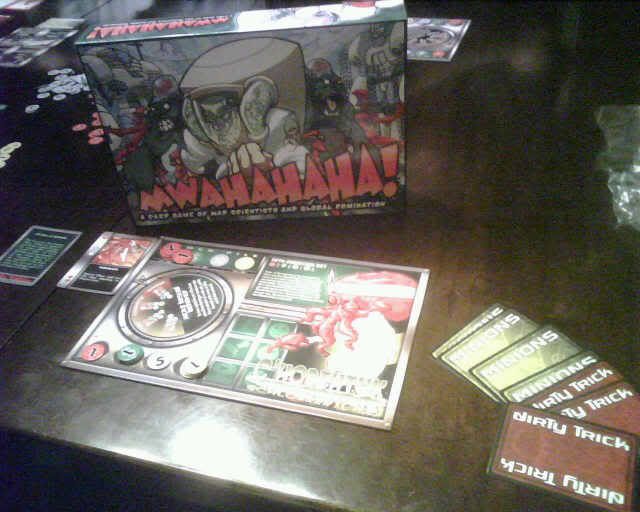
At its core, MWAHAHAHA! is a card game where the players take the roles of different archtypeal supervillians trying to ransom the world with a superweapon you're attempting to build. The other players are trying to do the same thing, so conflict inevitably occurs with minions, resources, other assets are thrown into peril. There are several different scientist/villians to play as, and twenty different superweapons to try and complete. As you gather resources and other holdings, you steadily increase the power of your weapon, first threatening cities, then states, entire countries, then the whole world. The player that first successfully threatens the world wins the game.

The game has a lot of positives. The presentation and art of the game is first-rate. All the characters are well-drawn and given a lot of flavor. The minions and different businesses you can control also play well into the games irreverent but faithful theme. These are comedic villians, despite the wonton destruction of people and places. The dice-fest mechanics of conflict resolution also work surprisingly well. Initially, we were worried that we'd get to the endgame too soon resulting in a stalemate and a grind that would be long and boring. The game's end came at a good point, and we ended up enjoying the experience.

With 10 different mad scientists to play as and 20 machines to build, you'd think that there'd be a lot of replay value. I'm hoping that this is the case, but the biggest obsticle to this is the mad scientist characters themselves. Unlike the different races from Twilight Imperium, the characters available in MWAHAHAHA! have very few mechanical differences. In fact aside from the card art and what resources they are able to better produce, there are no differences between the villians. All of them have the single ability to spontaneously produce the resources they are least able to refine. It's an OK trait, but in the end game it's useless. It's pretty disappointing, as I was expecting the characters to have wildly differing powers, like bonuses to minion combat, or a bigger hand size, or resource penalies, etc. Anything that differenciates the characters in a game mechanics sense would have earned this game a lot of credit. I see this as the game's only flaw, but it's a rather large one. I'm considering adding a desk of cards where each player is given a character quirk or benefit. One might be "Inspirational: All minions fight at +1 die", or "Small-Minded: +2 die to threaten a city, -1 to threaten world", or even something like sacrificing minions to get extra successes in combat or threats.

I give MWAHAHAHA! a 5/10 VP. The game will most likely be played again, and the theme, mechanics, and art are all quite cool. It's fun and definately something different to get onto the table.

Thursday, May 15, 2008

Take me down to the Liberty City!!!

Where the blood runs red and the bodies are plenty!!!


You might have noticed a little lack of updates, and truthfully this review was supposed to be up about a week ago. My time playing GTA IV has been most addicting. Remember when I mentioned a while ago my obbession w/ RPGish games? This isn't quite as bad, but it's been taking up most of my free time with the running and shooting and robbing and... bowling.

Grand Theft Auto IV is an immersive, expansive experience. In between the driving, the shootouts, and the intrigue, it's almost too easy to not notice just how realistic your surroundings are. Looking at the whole of Liberty City from the air or from the highway, it's truly marvel just how detailed the environments are. Granted, it's a lot less populous than the real NYC, but it's still a good play to have some mayhem.

All that said, the action in the game is intense. While most missions consist of find guy, fight goons, kill guy, several missions are reenactments of famous movie scenes. The one that stands out the most is Three Leaf Clover, which is almost bullet for bullet a recreation of the robbery sequence from "Heat". It's a thrilling mission, and for me the highlight of the game so far.

While many critics are quick to heap massive amounts of deserved praise onto the game, GTA4 is not without flaws. It takes a good couple of hours to get to any missions where you shoot anything. It's a really slow start that almost turned me off of the game completely. Fortunately things picked up right when they needed to, and it's been a hell of a ride since. I'm almost done with the story missions, and after I'm done it's off to the various side missions. Driving is also a bit frustrating, especially with the cheap cars that handle like lawnmowers on an ice rink.

GTA4 is among the top three games for the 360, right up there with The Orange Box and Halo 3. I give it a 9/10, as it's pretty damn close to being perfect. Believe the hype, and take a trip to the LC.

Friday, May 2, 2008

Shadows Over Camelot

Cooperative board games are a strange animal for some. For most people the idea of just about any game is to win over your opponents. Cooperative games like Pandemic or Shadows Over Camelot present a different challenge in that the only opponent is the game itself, and order to win the entire team must work together to overcome obstacles together. This can be a problem if your team is made up of jerks like mine usually is.

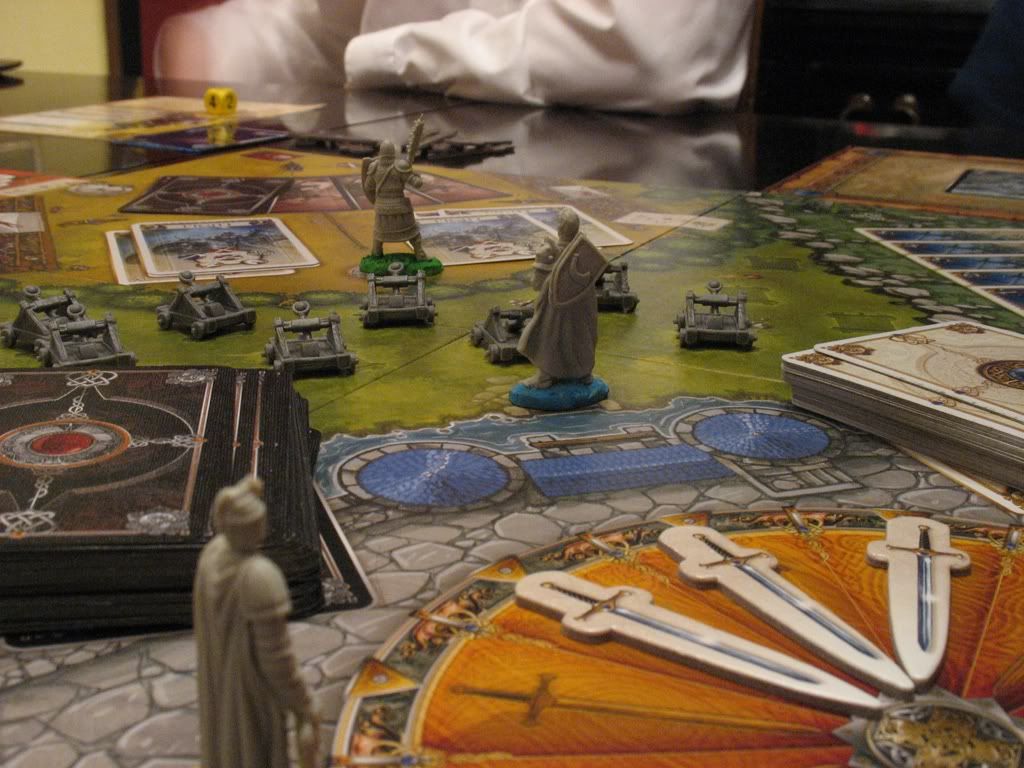
Jerks aside, Shadows Over Camelot takes place in the time of Arthurian legend with each player taking the role of a different Knight of the Round Table including King Arthur himself. Players take turns attempting several tasks, either challenging opponents like the Black Knight, questing for artifacts like the Holy Grail or Excalibur, and defending Camelot of seige engines and barbarian invasions. All the while the loom of evil advances every turn, either hindering quests or adding invaders to the board. Sometimes it feels like the game is actively trying to kick each and every one of the players in the junk while at the same time using the players loved ones as a humping post. There also may be a traitor in the midst of the players, and the only way for the traitor to win is for the entire team to lose.

The game is rather difficult for the Knights to win, even without the traitor covertly working against them. Often times the Knights are just a breath away from dying, have an army of catapults at Camelot's gate, and are losing the quests for the Grail and Excalibur. This can be pretty straining on the nerves of the players, especially if they feel like nobody's helping them on "their" quest. That said, it's a pretty satisfying accomplishment when you actually do end up winning the game, especially if you've also managed to ferret out the traitor.

This game gets a 7 of 10 VPs. It's always fun to play with the right group of people, but it's no fun at all if you get a player that particularly whiny and selfish. Still the theme, the beautiful art, and the detailed pieces all combine for an excellent and different offering for your gaming knight.

Yes that was both intentional and lame. :)