Monday, July 6, 2009

1960: The Making of the President


Sometimes it dawns on me how lucky I am in terms of the people I play games with. All of my various gaming groups are of a pretty good size, ranging from my XBox Live friends list which is almost maxed out, to my board gaming group which stands at a healthy 15-20 members, to my D&D group which is at a comfortable 4 or 5 depending on the day. This makes for a good size group whenever the mood strikes me to play a certain game as well as for a great amount of regular gaming. I don't mention all this to brag, but it does mean that certain types of games have simply passed me by, two-player games being a good example. Wherever I am playing just about any game there's always a need to try and include as many players as possible, simply because there are a lot of people I want to play with. I used to think two-player games made for an inefficient use of one's gaming time with other people. It's only been recently that I've begun to come around and start trying some two player games for myself. Battle Line was the first two-player only game that I really enjoyed and continue to play, but it's a quick game that's best played in small doses. I can see the need for a two-player gaming experience that has all the meatiness and depth of a full-on multiplayer title like Power Grid or Agricola, but specifically designed for two players in mind.

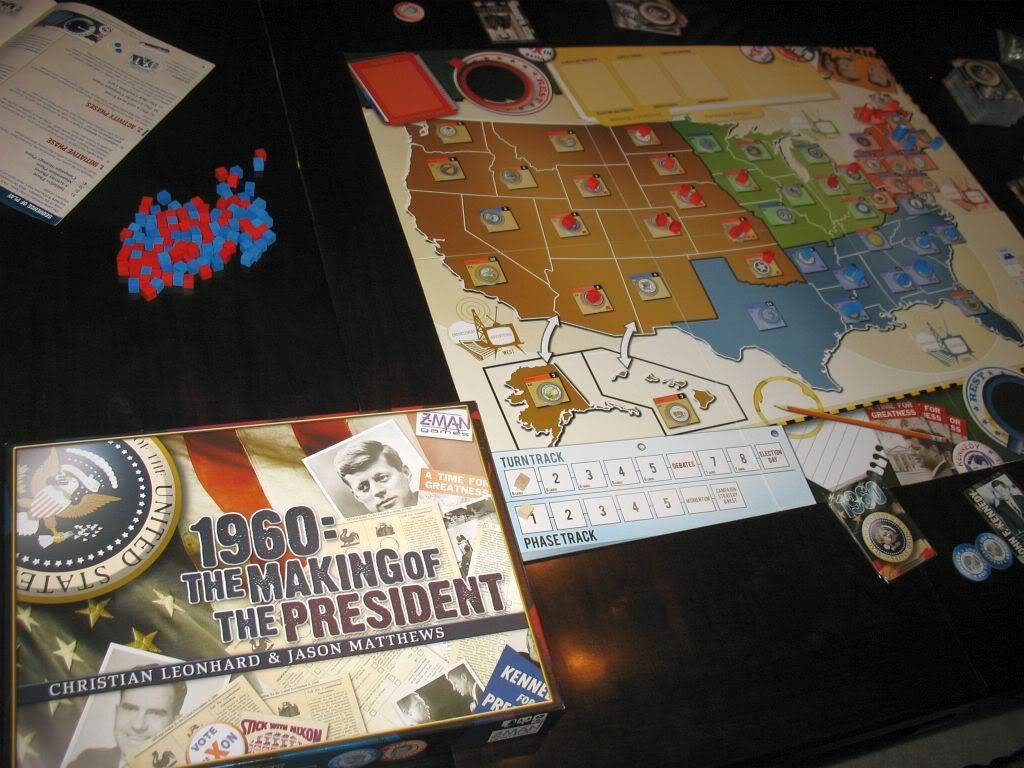
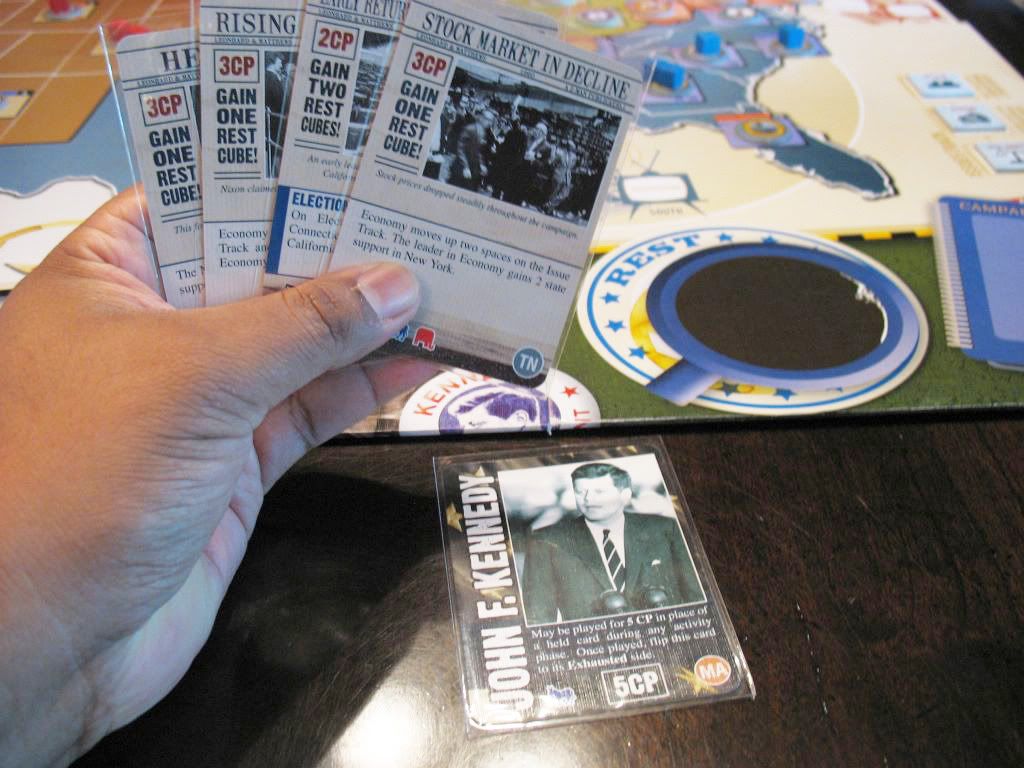
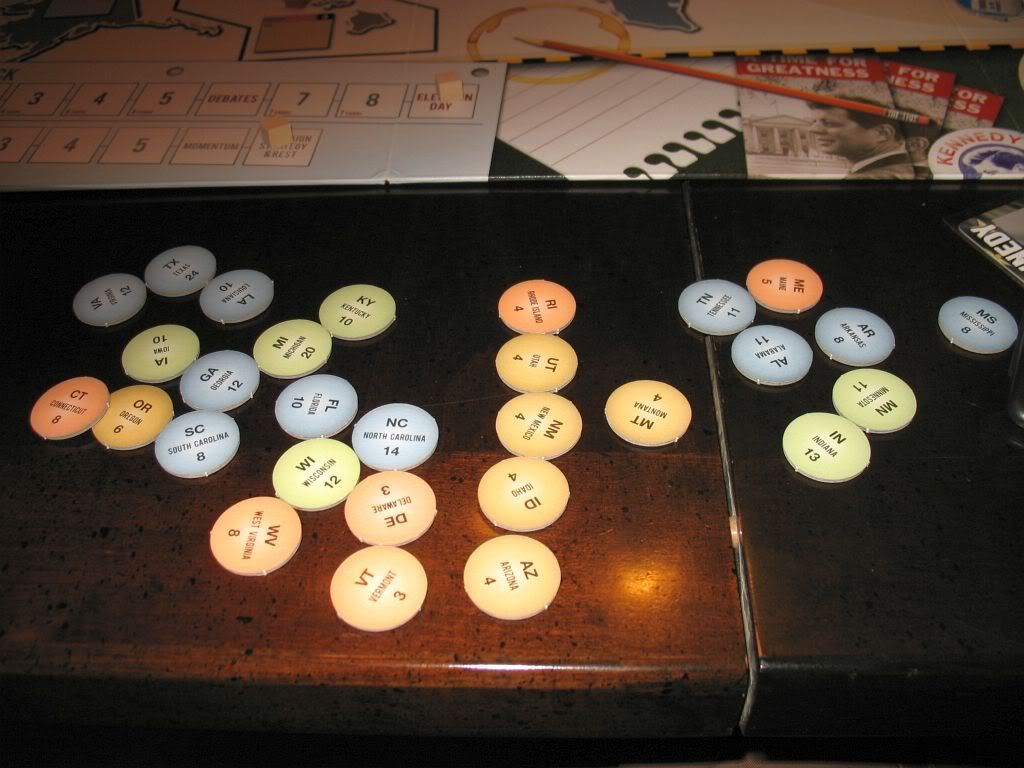
1960: The Making of the President is such a game. As the title suggests, the game is all about the 1960 presidential election between Kennedy and Nixon. The game takes place over the nine week period leading up to and including the presidential election. Players take turns using event cards to help their campaign or hinder the opponents. There are many options to use your resources on, including the basic and critical taking of states, and the more nebulously helpful advertising and the support of issues like Defense, the Economy, and Civil Rights. Cards take the form of events and groups of the era, like the Harvard Brain Trust, Faithless Electors, and Baptist Ministers. Obviously some of these events will help out Nixon, while others will assist Kennedy, and still others are beneficial to either player.

The game is all about balance and counter-balance. Every card can be used either for raw Campaign Points or for the potentially more helpful effect or event. Even when cards are burned for Campaign Points, the opponent might still be able to activate the event on the card, so care must be taken when playing any cards that might hurt you more than assist. Every action in the game is a risk vs. reward decision, especially when preparing for the special Debate and Election turns.


The game requires a much leaner style of play than you might expect. Despite the number of turns that you have available to the players, there's not a lot of room to mess around and waste actions. Thankfully the game is pretty straight forward in it's mechanics, so it's pretty easy for a first-time player to get right into the game after a brief rules overview. It's helpful to keep in mind the old saying "A good offense is the best defense" as this particularly rings true in this game. Chasing your opponent around the board trying to take back the states he's turning against you is a sure way to a ass-beating, so it's best to just play your game, and use the opportunities presented to you to make your moves and play your game.

1960: The Making of the President is a fantastic game. Calling it merely a really good two-player game simply doesn't do it justice. This is simply a really good game. The only concern I might have would be replayability, since the game is entrenched in a theme that only had one outcome, it wouldn't be plausible to make a 1960: The Revenge of Eisenhower or some such. There are plenty of Campaign Cards to make things interesting, and it would be possible to expand that pool of events to allow for different strategies and effects. This concern isn't particularly overwhelming, as this probably isn't going to a game that's going to hit the table too often. Unless you're gaming group is a more of a gaming duo, in which case you have my sympathy. Just kidding.

8/10


In the spirit of full disclosure, I played my first game as Kennedy, and ended up losing the election 276 to 261. OMG HISTORY HAS CHANGED!!!
Saturday, July 4, 2009

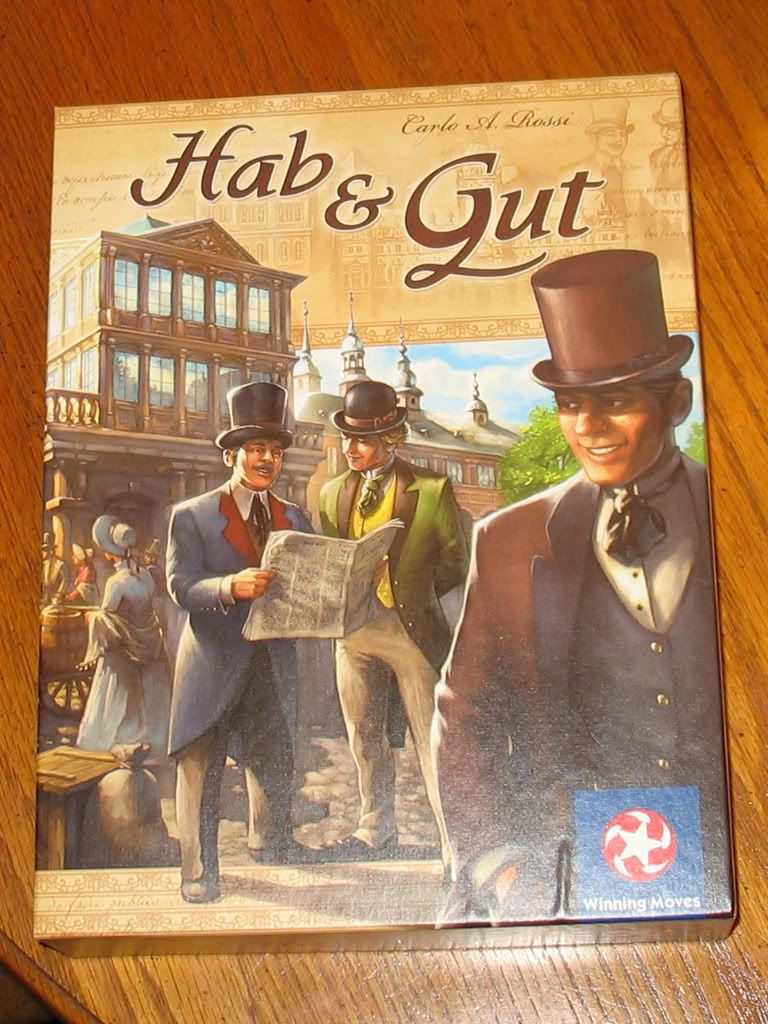
Hab & Gut


When I was in high school, the coolest personal electronic device that I or any of my friends had was our graphing calculators. Whether it was a TI-85 or an HP-48G, it was the most awesome little computer you could have at the time. Not because it was handy in class, but because they could play games. Many times these games were programmed by kids in school, and one of the easiest games to find was what was generally known as The Drug Dealer Game or Dope Wars. Essentially in the game, you had one month to pay off a specified debt. You made money by using what money you had to buy drugs at a certain price. You’d then try and sell those drugs later at a higher price. This was a staple on many calculators and cell phones, and this game mechanic has been present for a while in the realm of board games.


One such game is
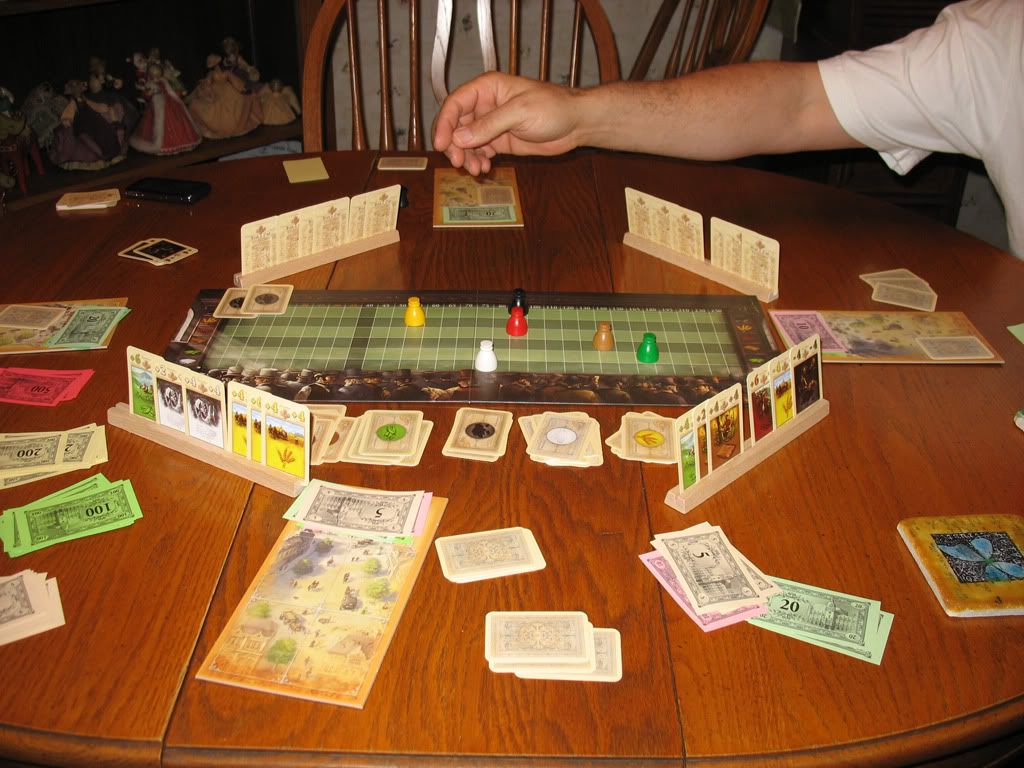
Hab & Gut (roughly translated to “Possessions” in English). This game is pretty straight forward. Buy low, sell high and end up with the most money at the end. Just like dealing drugs on your calculator, right? Pretty much it’s similar, except for a couple of important differences. First off, every player has a direct influence on the state of the market. As you can see, there are four racks of cards that are capable of changing the value of a given commodity. Each player is able to see two of these racks, and every card in each rack must be played in the round. From this information, the player is able to formulate a strategy in their buying and selling.


The other difference in the game is pretty important too. It’s not enough to simply make a lot of money in this game. Additionally, players have the option to donate goods to charity, and later sell those goods for their value with the money again going to charity. Much like
the follower of Sobek in Cleopatra, the person who donates the least amount of money to charity automatically loses the game, regardless of their final overall score.


The game is pretty random, as you don’t know about half of the information you’d need to create a strategy. As a player, you must not telegraph your moves too quickly, as you’ll find the other players quickly sending the value of your chosen good to the bottom basement of the value track. Plays on goods must be subtle at first, as obvious buying strategies are quashed rather fast.


Overall the game plays pretty fast and makes for an enjoyable play. I’d recommend this for any one who enjoys investment games like
Medici or even Winner’s Circle/Royal Turf. 6/10.


Monday, June 29, 2009

Vegas Showdown

Most of the time when I review a game, it’s after one or two plays and it’s really more of an off-the-cuff first impression. This isn’t necessarily a bad thing, since I play a lot of games and if I really waited to review a game until after the 9th or 10th play I’d get even less done than I do now. This is why it’s nice to review a game like Vegas Showdown, a game I’ve played a lot and feel like I’ve got a pretty good handle on.

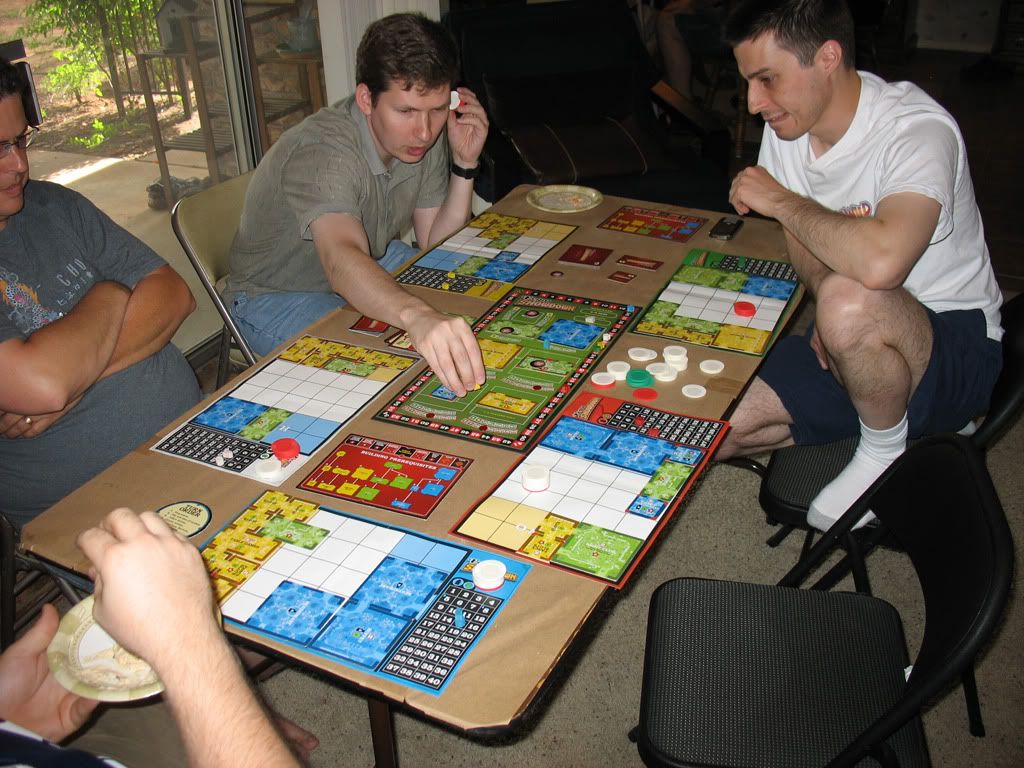
Vegas Showdown is part puzzle game, part resource management exercise, and part auction game. Obviously it’s a Las Vegas themed game, as you take the role of a casino manager building the best place on the strip. You start with a blank grid, some money, and some people, and go from there. You add restaurants, games, lounges, and other attractions until the endgame conditions are met and a winner is declared. The winner is determined by a combination of casino design, accumulated fame, and money.

All this sounds very clinical, but there are plenty of random elements that keep the game interesting. There are events that can affect how much money you get in a round, what attractions you can and can’t buy, and other wacky effects. This can affect your overall strategy pretty quickly. The game is a lot of fun when you get on a roll, but it’s important to try and stay generalized and take a wider approach to your victory. The game has some mechanics to push you to generalize, but finding the right balance is tough. Often the winning player doesn’t have the highest income or the most employees, but has enough to do the things that they need to do to win.


Vegas Showdown is a lot of fun, but even with all the random elements, it’s not as replayable as Twilight Imperium or Agricola, but it’s still interesting and makes for a good time. Its best played once in a while to stay fresh, but often enough so that you can try out new plans to make your place the best. It’s good enough to even forgive the rather minimalist art and board design. Overall, is a very solid game that should be hitting the game table with some regularity. 7/10.

Friday, June 26, 2009

Tribune


Some games are needlessly complex. Either they have a lot of mechanics going on at the same time, or a single overly drawn-out idea that ends up just being grinding and tedious. Arkham Horror is one of the needlessly complex games, with so much going on that forgets that the point is to try and have fun playing the game. Mystery of the Abbey is a deduction game that is convoluted to the point of silliness.

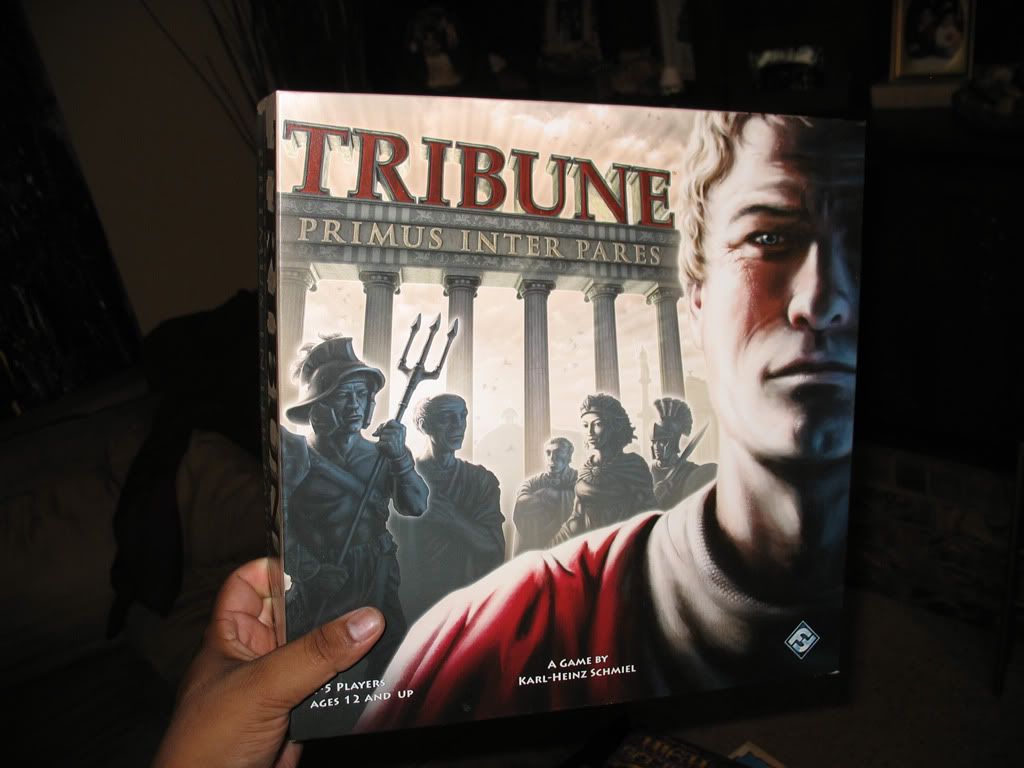
Tribune gets close to this level of pointlessness. When you get right down to it Tribune is a card game with a lot of extra bits, and I was so ready to hate this game when I realized that. It was like I was about to get ripped off, or hustled by the game's gorgeous art and seemingly weighty theme.

I'm happy to say that I was wrong, and Tribune manages to overcome it's overwroughtness and actually deliver an interesting and fun gaming session. Even though Tribune is a card game, it manages to deliver some rich game play and even manages to juggle a couple of different mechanics when aquiring cards and performing other options. The game's theme doesn't feel forced into the actual gameplay, as the different locations and their associated mechanics make sense in a historical sense, even if only a little bit.

Tribune is a good game. The play is a little awkward at first, but once a couple of rounds are played, it comes pretty easy. I look forward to playing again, and not getting my ass handed to me quite as severely next time. 6/10.

Wednesday, June 17, 2009

Roads & Boats

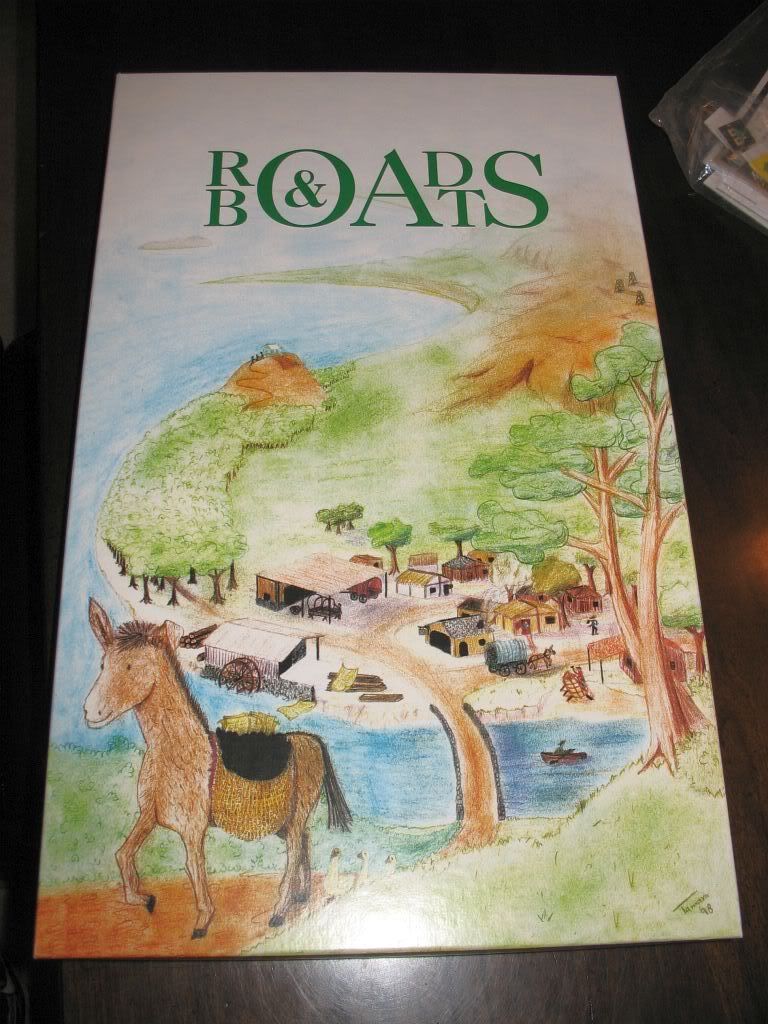
Some games regard themselves as rather epic. From the giant boxes of Twilight Imperium the thousands of pieces in Heroscape, some games are huge spectacles of gaming grandness, and they are well aware of that. Roads & Boats isn't that self-aware, despite being a rather epic game itself. It's difficult to describe, but Roads & Boats has a down-to-earth mentality that pervades the entire experience. From the manual that speaks plainly and unobtusely, to the simple bits and hexes, the game is almost humble in its presentation.

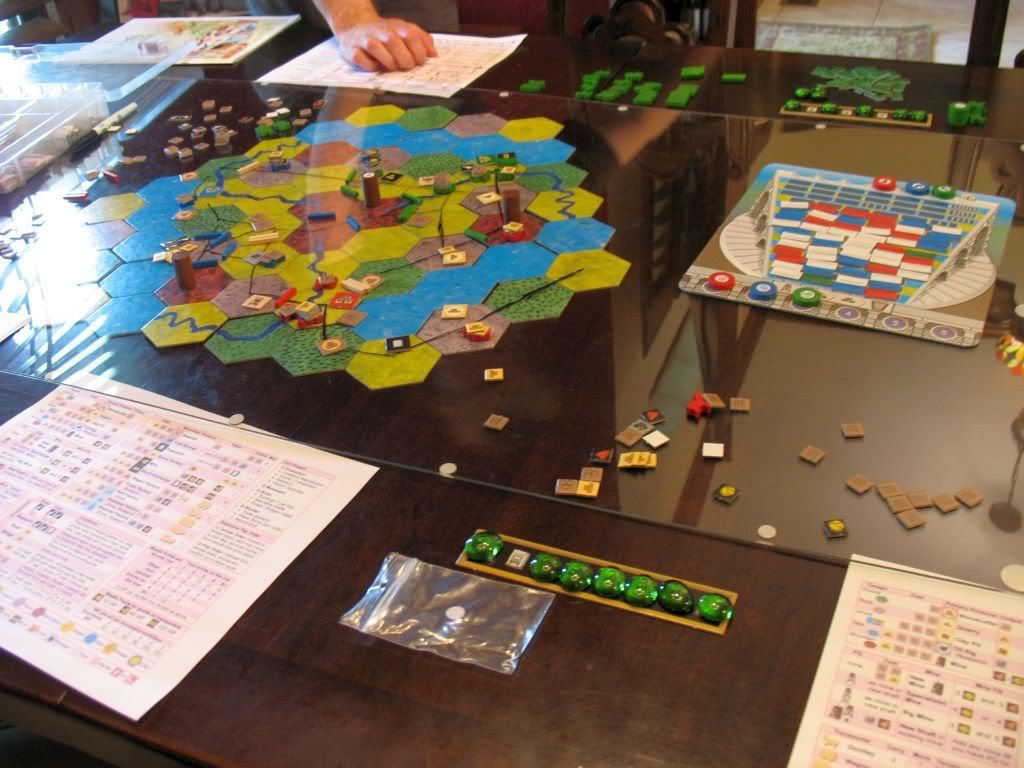
The game itself is rather unique, as it throws every notion that players have of ownership and territory out the window. In Roads & Boats, you have a home hex and some transportation vehicles. Eventually you'll get some goods on those transporters and build yourself some walls, and that's the extent of "your" stuff in the game. Everything else, every other building, good, or other resource is up for grabs belonging to no one. People will violate "your" territory constantly and take "your" goods to go make other goods. As Yoda once said, "You must unlearn what you have learned". You can't sit back and just try to meaninglessly defend what you might think is your lands just because you started there. You need to stay mobile, keep producing, and work to make stuff and score points.

Roads & Boats takes some getting used to, but it's still a well-designed and engaging gaming experience. If nothing else, you really ought to play simply for the opportunity to broaden your gaming horizons and learn to think differently on the fly. The game's landscape can change rather quickly, so if a long-term strategy becomes no longer viable, you have to adapt or abandon your original plan. This is mostly true of other games, but it can be surprising how fast things can change in Roads & Boats. All in all, it's a wonderful game that I look forward to playing again. 8/10.


Wednesday, June 3, 2009